Over the Farm Gate, kindly provided by John Jefferies, Farmer Director
In the months since my last update so much has happened. The harvest came and went in the blink of an eye. It was disappointing. The excess of both heat and drought during the previous months had taken a great toll and was a leveler. All crops across all local farms were equally affected and yielded broadly the same grossly disappointing amount; but the differences in farming methods and decisions made are still presenting themselves as we head towards the next farming year.
The early harvest did present opportunities though. I enjoyed not one, but two holidays with my family in August. Also, at the end of July I was able to qualify for the finals of the All England Golf Croquet (handicapped) tournament. The early harvest allowed me to practice between 2 and 8 hours a day for the finals.
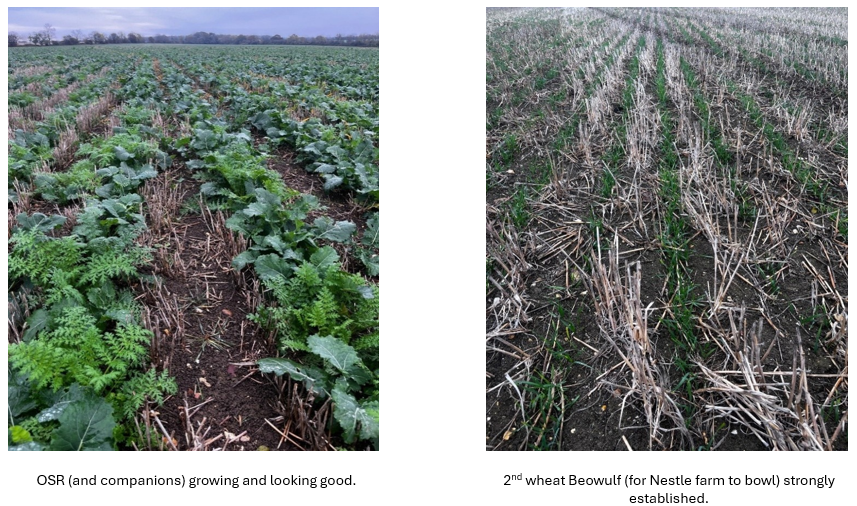
Finally, rains came in late August, which were instantly evaporated by the beating sun. It was only as we entered September that I finally accumulate adequate moisture to consider drilling Oilseed Rape. This was duly done on September 3rd and 7th. The gap allowed for the croquet finals and the drill to be reprimanded and fixed for inconsistent seed metering. The OSR grew rapidly. The earlier drilled field suffered a degree of damage from Cabbage Stem Flea Beetle, whilst I managed to arrest the damage in the second field by using waste from the fish processing industry. This makes the fields smelly and causes the insects to go elsewhere. I was skeptical about the suggestion of using this product and was proved entirely wrong. All of my rape seed is now growing vigorously.
I delayed my wheat drilling until October 12th. Partly due to a plan to drill later and partly due to my inconsistent drill playing the fool again. I did actually start on the 8th but gave up after 5ha as the drill was spending more time not metering seed than metering seed. But I did finally nail down the second fault, the tiny little box that translates the speed radar signal to a signal that changes the motor speed accordingly. After a weekend of childcare I was off and out of the blocks after school drop on Monday and bagged 42ha of trouble-free drilling by nightfall. Wheat drilling was completed by the following Monday, the last field going into some dry lumpy conditions following forage maize. All of the wheat has now emerged and is growing rapidly. So far, no aphids have been seen, and blackgrass control is good.
As mentioned, the OSR is a vivid lush blue/green. This is a sign of excess nitrogen and shows just how ineffective our fertilizers were last season. Every crop of OSR locally looks this same colour, except one. That is my field that followed Winter Oats, which are known for their deep rooting and ability to strip nitrogen out of the soil. In the spring the crop looked quite advance, so I held back on the nitrogen fertilizer. The season progressed and the heat and drought meant that applying any fertilizer would be a waste of money. The Oats did look quite hungry. But they yielded 6.5t/ha, had a very good specific weight and cost very little to grow (just one cheap fungicide for mildew). My OSR that followed my Spring Barley is blue/green. Particularly disappointing as the barley was 2.1% N and still left excess nitrogen in the field. Neighbouring crops of OSR that followed wheat on full nitrogen (and in one case with seedbed N) are all showing massive amounts of growth. I have found this pleasing, as it backs up my decision to stop applying fertilizer during the drought last spring and the stock (approx. 40% of usage) carried over to the next season in my shed represents a huge saving. Also, the fact that my wheat yielded the same as my neighbours that had full N confirms the decision.
But sitting here, planning next year and not knowing what to do. I still have a soil moisture deficit, and I need quite a lot of rain to secure next harvest. Without the rain, yields will again be restricted. I have also attended some online and in person events. One significant piece of data was just how damaging heat is to a flowering wheat crop, reducing yield by 1.5t/ha when compared to a drought year without heat at flowering. Drought also restricts yield and this influences optimum fertilizer. One answer might be to complete all fertilizer applications by the end of February. But having all your fertilizer in the field doesn’t mean it is all going to be used by the crop. We saw that this year where farmers fertilized for a 11t/ha crop and got 7t/ha. An answer might be to put on about 60%-70% and apply a foliar fertilizer as required. But there seems to be no data to backup this approach. I hope to lesson learn much more about this over the winter. It is known as Nitrogen Use Efficiency. Vital given the cost of fertilizer.
…. and the croquet finals. There were 14 finalists and we all played each other once, over the course of 2 days. In the middle of the first afternoon I lost concentration in one match and found myself 3-0 down after 3 hoops. I kicked myself and got back to 6-6. At the final deciding hoop I misjudged a 25m shot by about 8cm and knocked my opponents ball directly in front of the hoop, thereby losing 7-6. A day later that turned into the difference between winning the tournament and coming second. Very small margins. I did, however, absolutely thrash the competitors who came 1st and 3rd , beating them both 7-1. A small consolation of what could have been.